
Ownership / Overheating and Cooling
Triumph Stag Cooling Upgrades
The parts and modifications that keep a Stag cool, in the order worth doing them.
The Triumph Stag's overheating reputation is entirely curable, but the trick is to find the actual cause before spending money. Practically anything can make a Stag run hot, from a tired water pump or retarded ignition to silted waterways or simply a cooling system that was marginal when new. This guide sets out the causes in the order to check them, then the fixes and upgrades that keep a sorted Stag reliably cool: correct corrosion-inhibiting coolant and a good thermostat, an uprated radiator and electric fan, a raised header tank, and a healthy water pump. Done properly, a Stag V8 covers big miles without drama.
This page is about the hardware: which parts and modifications improve the system. For the diagnosis side, why a Stag overheats, how to tell whether yours is doing it and what to do at the roadside, start with the Stag overheating guide.
1. Why the Stag overheats
The Stag V8 is a mixed-metal engine: an iron block with alloy heads. Without a corrosion-inhibiting coolant that pair silts up with electrolytic corrosion, waterways narrow, and heat has nowhere to go. Early blocks left the foundry with casting sand still trapped in the water jackets, which migrates and blocks passages, particularly around the rear cylinders. The header tank is mounted too low to bleed cleanly, so trapped air pockets are common. And because the factory temperature sender reads only one cylinder head, one bank can overheat unseen while the gauge still shows normal. Add a cooling capacity that was marginal from new, and the reputation writes itself.
None of this is a reason to avoid the car. Every one of these issues is understood, and the community has been refining the fixes for decades. For the deeper engineering story, see the V8 Engine page, and for symptom-led diagnosis of a currently-overheating car see the Fault Finding database.
2. The causes, in the order to check them
Overheating is a symptom, not a diagnosis, and on a Stag almost anything can cause it. Before spending on hardware, work out which of these is actually at fault. A proper diagnosis first is what separates a cured car from an expensive guess.
- Coolant level and quality. Low, weak or exhausted coolant is the commonest cause. The water pump sits high in the engine, so even a small loss drops the level below it and circulation stops.
- The water pump. A genuine Stag weak point (covered in detail below), and a failing one causes rapid, serious overheating.
- Airflow. A tired or wrongly wired fan, a missing fan cowl, or a radiator the air slips around rather than through.
- The thermostat. Stuck, wrong rating, or removed to mask a problem. Removing it makes things worse, not better.
- The radiator. Furred or silted internally, or an original core past its best. Check it is as hot at the bottom as the top; if not, coolant is not circulating.
- Silted waterways. Casting sand and electrolytic corrosion narrow the passages, especially around the rear cylinders.
- The tune. Retarded ignition timing and a weak mixture both make an engine run hot, and an air leak past the O-ring at the base of a Stromberg leans the mixture.
- Less obvious causes. A leaking intake-manifold gasket, a vacuum leak, wide exhaust valve clearances, sticking brakes, or, worst of all, a cracked block.
For a symptom-led walk through this, use the interactive diagnostics troubleshooter and the Fault Finding database.
3. The Stag water pump
The Stag's water pump deserves a section of its own, because it is one of the engine's genuine weak points and a classic cause of sudden overheating. Unlike most engines the Stag pump is not belt-driven: it is turned by a helical gear off the jackshaft, which is itself driven by the timing chain, the same arrangement used on the related TR7 and Saab 99 engines. And it sits high in the engine. That height matters, because if the coolant level ever drops, through a leak or a boil-over in traffic, it can fall below the pump before the gauge looks alarming, at which point circulation stops and the temperature climbs fast. Running the pump low also damages it, so a single overheating episode can leave you with a failed pump even after you top the system back up.
The pump has a second, nastier failure mode. On some pumps the drive gears were poorly hardened and wear prematurely, shedding hardened gear teeth into the engine. As the teeth wear away the pump slows and then stops, and you overheat, often warping a head before you can react. The shed debris is itself a hazard: if it reaches the jackshaft front bearing and seizes it, the timing chain that drives the jackshaft can jump or break, and on this engine a broken chain means the valves meet the pistons.
What this means in practice: keep the coolant topped up and leak-free so the pump is never run low, fit a good-quality pump from a reputable Stag specialist when the time comes to replace it, and treat any unexplained overheating as a reason to investigate the pump rather than press on. For the timing-chain side of this story, see the Timing Chains page.
4. What overheating does if you ignore it
This matters because the Stag punishes overheating quickly and expensively. The aluminium heads have a bad reputation for warping, sometimes after as little as 25,000 miles of hot running, and the TR7, which is effectively half a Stag V8, shares the trait. A warped head blows its gasket, and a blown gasket lets coolant seep around the head studs, where an electrochemical reaction between the aluminium head and the steel studs can seize them solid and make the head almost impossible to remove. There is little margin for recovery either: Triumph allowed only 0.010 inches to be skimmed from a head face before it had to be replaced, and a badly warped head exceeds that easily. This is why the golden rule with a Stag is never to drive on a rising temperature gauge. A ten-minute stop to investigate is always cheaper than a pair of heads.
The full story is on the Cylinder Heads and Head Gaskets page.
5. Get the basics right first
Many Stags described as “overheating” simply need the fundamentals done properly. Before spending on hardware, work through the following. In the majority of cases the temperature problem falls away here.
- The correct coolant. A corrosion-inhibiting antifreeze suitable for mixed iron and aluminium engines, mixed to strength and flushed annually. The factory specification is any solution meeting BS 3152, and names no brand. Weak or exhausted coolant lets the corrosion cycle restart, the single most common invisible cause of Stag cooling failures.
- A good-quality thermostat. Never run the engine without a thermostat. It is not just a warm-up device, it regulates flow through the block and helps the water pump build the pressure it needs to circulate coolant properly. Removing it makes things worse, not better.
- The correct pressure cap. The factory General Specification Data gives the system pressure as 13 lb/in² (0.91 kg/cm²), which is the early figure. The Vintage Triumph Register records that 20 lb caps became standard on later Stags and recommends the higher rating over the early one, naming Unipart GRC124. The higher-rated cap raises the coolant's boiling point and gives real margin in traffic on a hot day. Match the cap to the tank it seals against.
- Proper bleeding. There is a bleed point on the rear of the right-hand cylinder head. Use it. Air pockets local to a head will cause an apparent overheat even in an otherwise healthy system, particularly after any coolant work.
- Block the air gaps. Seal the gaps around the radiator and inside the front valance so incoming air is forced through the radiator core rather than slipping past it. It is a cheap, quiet improvement with a real, measurable benefit, and it is often skipped.
- Coolant capacity and filling. The system holds 18.5 imperial pints with the heater, given in the factory data as 22.3 US pints and 10.5 litres. Fill it with the engine running and warm and the heater on full hot. If a dry engine will not take the full amount, there is an air pocket still to bleed. Raising the front of the car helps, and so does holding the overflow bottle above the radiator as you finish.
- Hoses. Use reinforced, correctly moulded hoses, never universal accordion types, and renew them every five years or 25,000 miles, sooner if the car has ever overheated. The engine bay runs hot and tired hoses fail there.
- The fan cowl. The original fan is a 13-bladed plastic item of 16.5 in (418 mm) diameter, turned through a Torquatrol viscous coupling that slips to hold fan speed to about 2,500 rpm and limit noise and power loss. That ceiling on fan speed is deliberate, and it is part of why airflow at idle and in slow traffic is the weak point an electric fan addresses. Mark II cars from 1973 had a sheet-metal fan cowl that noticeably improves the engine-driven fan. Many were removed over the years when sagging engine mounts let the fan foul the cowl, which cured the noise but quietly worsened the cooling. If yours still has the metal fan, sound engine mounts and an intact cowl are part of the cooling system.
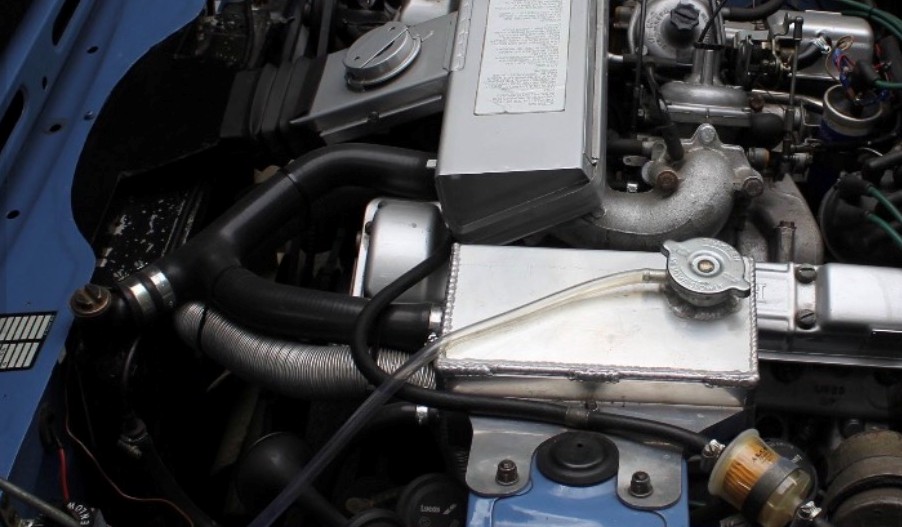
- The thermostat location. One Stag quirk to know: the thermostat lives in the intake manifold, not a separate housing, and the manifold carries coolant from head to head as well as warming the carburettors, which makes it the hottest part of the system. Its gaskets have only a narrow band of material around the coolant ports and are a known leak point.
The thermostat trap, which almost nobody is told about
A Stag thermostat has a second job that most thermostats do not. Behind it sits a bypass port, which lets coolant reach the water pump by way of the inlet manifold while the engine is cold. That warms the manifold quickly, which keeps the carburettors happy and stops fuel condensing on the manifold walls. As the engine comes up to temperature the thermostat has to close that bypass port at the same moment as it opens the path to the top hose, and it does that with a blanking disc on its underside.
Most thermostats do not have the blanking disc. Fit one of those and the bypass never closes, so the water pump draws from the hot side and the cold side of the radiator at once. That raises the temperature of the coolant going back into the engine and cuts the volume passing through the radiator. The car now has a new thermostat and a worse cooling system, and nothing about it looks wrong.
Three units that do have the disc are named in the Vintage Triumph Register's Stag cooling material: the Unipart GTS 101, the Robertshaw 412-180 and the Stant 35398. The Unipart item also carries a small bleed hole and jiggle pin, which helps air out of the system as it fills. The two aftermarket units do not, and the same source describes drilling a 1/8 in hole in the stationary part of the thermostat to do the same job. Whichever you fit, put the bleed hole or jiggle pin at the twelve o'clock position.
The thermostat opens at 82°C.
6. The upgrade menu, in priority order
Once the basics are right, the following upgrades are listed in the order most Stag owners come to recommend them. Money spent near the top of the list gives more temperature back per pound than money spent near the bottom.
Uprated radiator , high priority
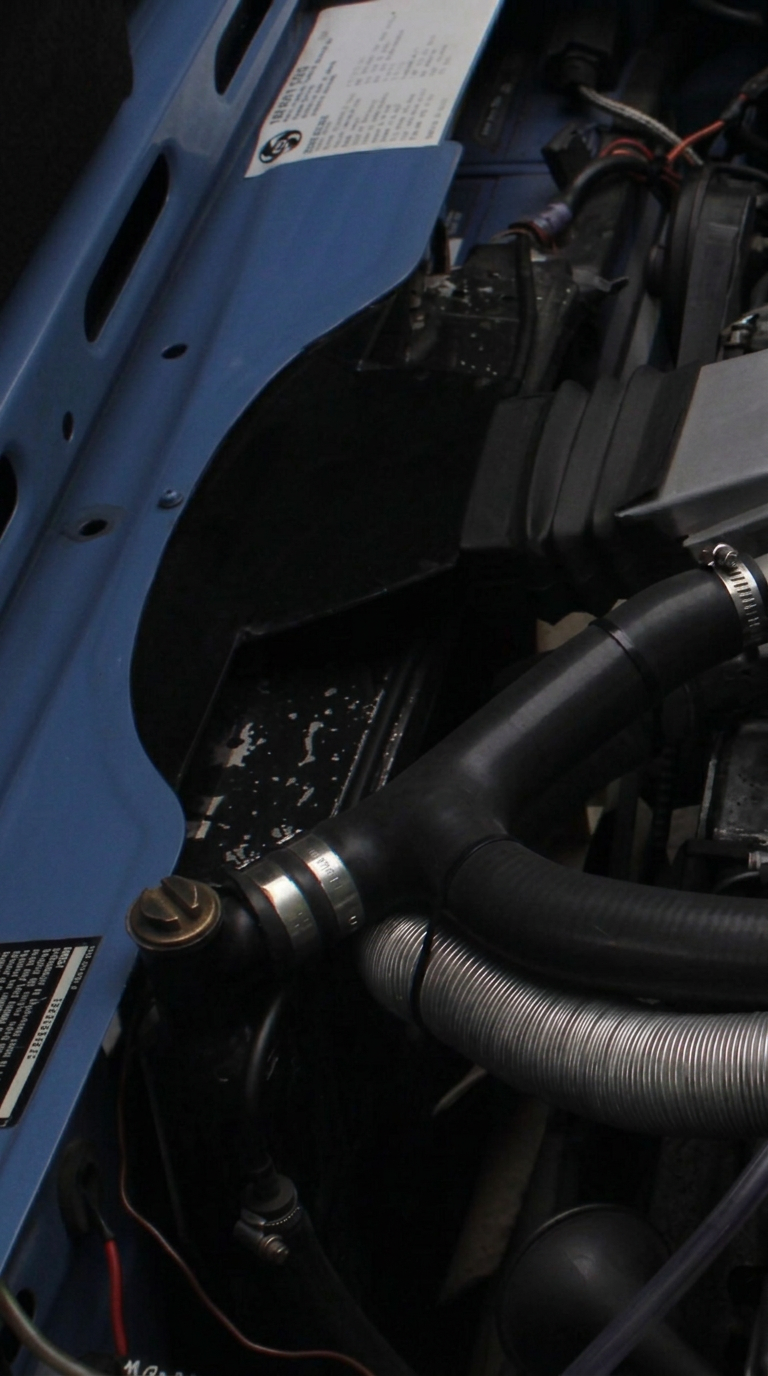
The single best cooling upgrade. Two respected routes: a modern aluminium radiator, roughly half the weight of the original (about 5 kg versus 10 kg) and usually supplied with a boss for a fan-thermostat switch, or a high-quality re-cored brass/copper radiator. A well-made three- or four-core (such as the specialist “Staggard”-style uprated units) can match or beat the original. Either gives quicker heat rejection and a faster return to normal after a hard run followed by a stop.
Electric cooling fan , high priority
An electric fan gives full airflow at idle and low speed, exactly when the engine-driven fan does least and the car is most likely to boil, and continues to draw air after switch-off, reducing heat soak. Popular quality brands include Kenlowe, Revotec and Davies Craig. A useful side effect: it removes the risk of the crank-driven fan fouling its shroud when the engine settles on its mounts.
Raised / upgraded header tank , high priority, low cost
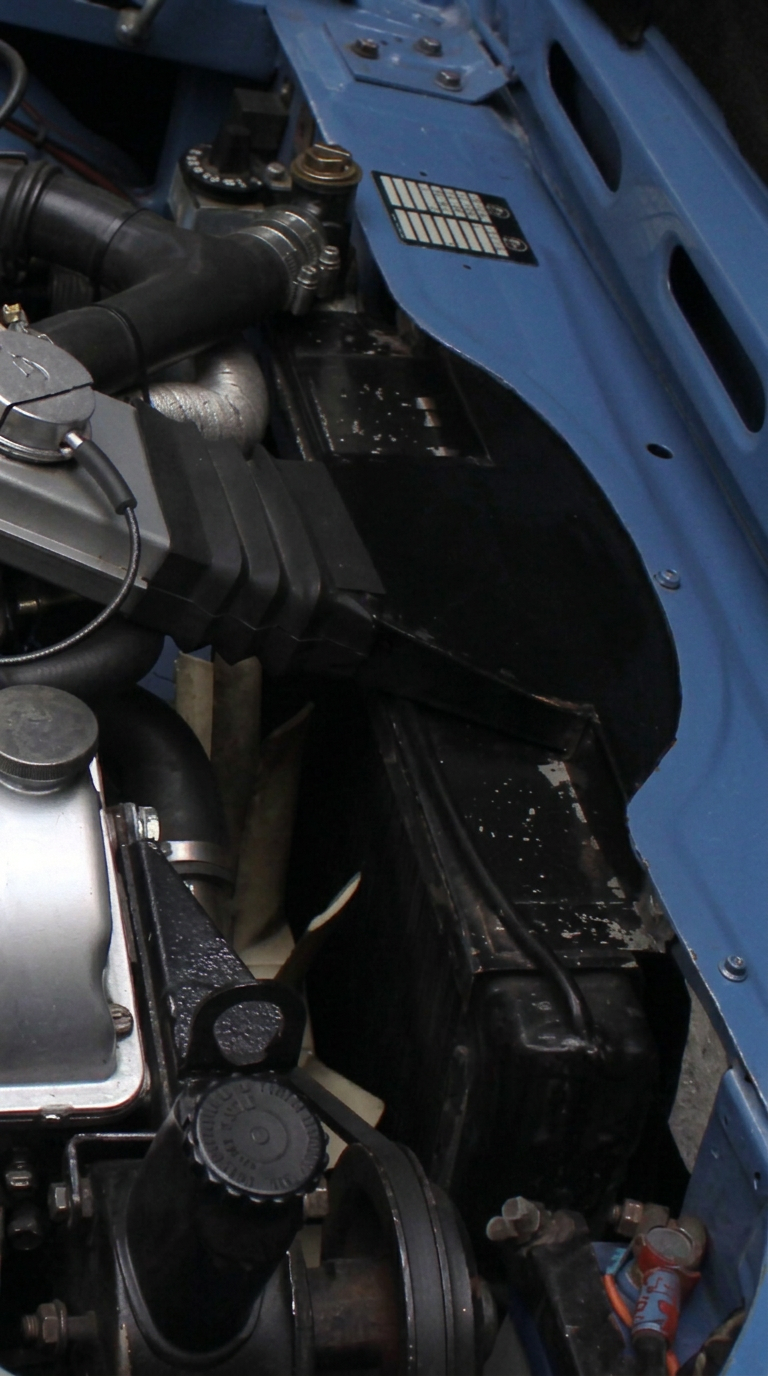
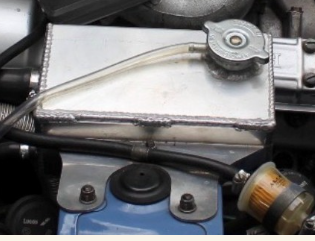
The original header tank being mounted too low is widely regarded as a genuine design weakness of the Stag. Raising it : or fitting a good alloy header tank, some with a low-coolant float alarm, improves bleeding and long-term reliability. Pair it with the higher-pressure cap for the full benefit.
Electric water pump , optional / advanced
A system such as the Davies Craig EWP, fitted low in the circuit with a digital controller that also runs the fan and effectively replaces the thermostat, gives controllable flow and removes belt load from the crank. Presented honestly, it is a more involved conversion, the mechanical pump and its bypass have to be blanked, and most owners find they do not need it once a good radiator, electric fan and correct coolant are in place. Treat it as a further step, not an essential one.
Oil cooler , worth it for touring / spirited use
An oil cooler lowers oil temperature under sustained load, easing the thermal burden on the whole engine and protecting bearings and other internals. It is not usually necessary for gentle local use, but it earns its keep on long tours, hot motorway runs and enthusiastic driving.
Fully synthetic oil, changed regularly
Modern synthetics cope with heat and shed it far better than 1970s oils, which helps cool the heads directly. Change roughly every 3,000 miles on a Stag; fresh, in-spec oil is one of the cheapest and most effective things any owner does for the engine.
Waterless coolant , the debated option
A genuine trade-off, presented even-handedly. Waterless coolant (for example Evans) will not boil over and continues to inhibit corrosion, which can prevent a catastrophic failure. But its heat capacity is lower than water's, so a marginal system can actually run hotter on it. The balanced view: only consider waterless coolant once a good radiator and electric fan are already fitted. Most Stag owners find correct inhibited coolant, plus a sorted radiator and fan, is sufficient.
A second temperature sender / gauge , cheap insurance
Because the factory sender reads only one head, fitting a second sender and gauge on the other bank, or spot-checking both banks with an infrared thermometer, removes the blind spot that lets one side overheat unseen. On the Stag V8, this is the cheapest single piece of insurance available.
Comparison table
| Upgrade | Benefit | Priority | Rough cost | DIY or specialist |
|---|---|---|---|---|
| Correct coolant + good thermostat + right pressure cap + bleed | Restores the system to how it should have left the factory | High (low cost) | Consumables | DIY |
| Block air gaps in front valance / around radiator | Forces incoming air through the core, not around it | High (low cost) | Very low | DIY |
| Uprated radiator (aluminium, or 3/4-core re-core) | Single biggest improvement, quicker heat rejection | High | Get a specialist quote | DIY or specialist |
| Electric cooling fan (Kenlowe / Revotec / Davies Craig) | Full airflow at idle and after switch-off; reduces heat soak | High | Get a specialist quote | DIY or specialist |
| Raised / upgraded header tank (alloy, with low-coolant alarm option) | Better bleeding; addresses a genuine design weakness | High (low cost) | Modest | DIY or specialist |
| Second temperature sender / gauge on the other head | Removes the single-head blind spot | Medium | Low | DIY |
| Oil cooler | Lowers oil temperature under sustained load; protects internals | Optional | Get a specialist quote | DIY or specialist |
| Fully synthetic oil, changed ~3,000 miles | Sheds heat better than 1970s oils; helps cool the heads | Medium | Consumables | DIY |
| Electric water pump (e.g. Davies Craig EWP + controller) | Controllable flow; removes belt load, advanced conversion | Optional | Get a specialist quote | Specialist |
| Waterless coolant (e.g. Evans) | Will not boil; inhibits corrosion, but lower heat capacity | Optional | Higher than conventional | DIY |
Costs are deliberately not quoted where they are not in the archive, budget accordingly and get a specialist quote for the work in question.
7. A sensible upgrade path
- Get the basics right: correct coolant, good thermostat, correct pressure cap, proper bleed, and block the air gaps around the radiator.
- Fit an uprated radiator, the single biggest single-item improvement.
- Fit an electric cooling fan for idle-and-low-speed airflow and to reduce heat soak after switch-off.
- Sort the header tank: raise it, or fit a quality alloy tank, paired with the higher-rated pressure cap.
- Optionally: add an oil cooler, an electric water pump, and a second temperature gauge on the other head. These are further steps, not essentials.
8. Maintenance to keep it cool
- Annual coolant flush and renewal, corrosion inhibitors are consumed over time, and refreshing the coolant is the cheapest protection there is.
- Keep the idle high enough for good coolant circulation and healthy oil pressure; a Stag lugging along at too low an idle runs hotter than it should.
- Inspect hoses at every service; consider a full silicone hose kit for long-term reliability.
- Do not ignore a creeping gauge. Investigate promptly, a slow-rising Stag temperature is telling you something specific, and it is always cheaper to catch it early than to catch it in a warped head.
Frequently asked
Why does my Triumph Stag overheat?
The Stag V8 was delivered with a marginal cooling system feeding a mixed-metal engine (iron block, alloy heads). Without a corrosion-inhibiting coolant the waterways silt up with electrolytic corrosion; casting sand left in early blocks restricts flow; the header tank sits too low to bleed cleanly; and the single-head temperature sender can hide one bank overheating. Sorted properly, correct coolant, good radiator, electric fan, raised header tank, the engine runs reliably.
What is the best radiator for a Triumph Stag?
The two respected options are a modern aluminium radiator, which is roughly half the weight of the original (about 5 kg versus 10 kg) and usually supplied with a boss for a fan-thermostat switch, or a high-quality re-cored brass/copper radiator such as a three- or four-core specialist unit. Both give quicker heat rejection and a faster return to normal temperature after a hard run followed by a stop. Either is a bigger single improvement than any other cooling upgrade.
Should I fit an electric fan to my Stag?
Yes, an electric fan is one of the highest-value cooling upgrades. It gives full airflow at idle and low speed, which is exactly when the engine-driven fan does least and the car is most likely to boil, and it keeps drawing air after switch-off to reduce heat soak. Popular quality brands include Kenlowe, Revotec and Davies Craig. It also removes the risk of the crank-driven fan fouling its shroud as the engine settles on its mounts.
Do I need an electric water pump on a Stag?
No, most Stags do not need one once a good radiator, electric fan and correct coolant are in place. A system such as the Davies Craig EWP, controlled by a digital controller that also runs the fan and effectively replaces the thermostat, gives controllable flow and removes belt load, but it is a more involved conversion (blanking the mechanical pump and bypass) and is best treated as a further step, not an essential one.
Is waterless coolant good for a Triumph Stag?
It is a genuine trade-off. Waterless coolant (such as Evans) will not boil over and continues to inhibit corrosion, which can prevent catastrophic failure. Its heat capacity is lower than water's, however, so a marginal cooling system can actually run hotter on it. The balanced view: only consider waterless coolant once a good radiator and electric fan are already fitted. For most owners, correct inhibited coolant, a sorted radiator and an electric fan are sufficient.
What coolant should a Triumph Stag use?
A good-quality ethylene-glycol antifreeze with corrosion inhibitors suitable for mixed iron/aluminium engines, mixed to the correct strength and changed on schedule, annually is normal on a low-mileage classic. Plain water, or coolant left in for years, is the fastest way to kill a Stag V8: it lets electrolytic corrosion attack the alloy heads and silt the waterways.
Why is the Stag water pump such a problem?
It is gear-driven off the timing chain through a jackshaft and mounted high in the engine, so it stops circulating if the coolant level drops, and some pumps had poorly hardened drive gears that wear out and shed teeth into the engine. A failure causes fast overheating and, at worst, timing-chain damage. Keep the coolant topped up and fit a good-quality pump.
Can ignition timing or mixture make a Stag overheat?
Yes. Retarded ignition timing and a weak mixture both raise running temperature, and an air leak past the O-ring at the base of a Stromberg carburettor leans the mixture. Always check the tune before assuming the cooling system itself is at fault.
How quickly can a Stag warp a head?
Overheated hard, sometimes within 25,000 miles. A warped head blows its gasket and can seize the head studs in the alloy. This is why you never drive on a rising temperature gauge.
Sources
Thermostat opening temperature, system pressure, cooling system capacity, fan specification and antifreeze standard: Triumph Stag Repair Operation Manual, Section 04 General Specification Data, which is headed as applying to early cars, and Section 26, Cooling System. The bypass port and blanking disc, the named thermostats, the 20 lb cap and Unipart GRC124, and the filling advice: the Vintage Triumph Register's Stag cooling material by William Mayo and Walter Holliday, with additions by Tim Buja. Where the archive has only one source for something, it says so rather than implying more.
A properly cooled Stag V8 will cover very high mileages reliably. Overheating is a solved problem, not an inherent flaw, and every fix on this page is available to any owner willing to work through the list in order.
Next: if the car is hot now, start with the interactive diagnostics troubleshooter and the Fault Finding database. For the related guides in this cluster, see Starting in Extreme Heat, Before a Long Run, Cylinder Heads and Head Gaskets, Timing Chains and the V8 Engine deep-dive. For the associated jobs see the How-To & Repairs hub, or head back to the Ownership hub.