
Ownership / Storage & Winter Care
Storing a Classic Car: Winter Layup, Garages and Dehumidifiers
By Jon Cosson
The enemy in storage is moisture, not cold. Everything that follows, the choice of building, the choice of dehumidifier, the argument about whether to start the engine, comes back to keeping water away from cold metal. This page compares the four storage environments most owners actually use, goes into dehumidifiers in proper detail, sets out the genuine disagreement over winter starting, and gives you a lay-up checklist and a spring recommissioning list.
For general advice that applies to any classic, see Jon Cosson's guide to classic car storage.
Recommended storage humidity
Aim to hold a closed garage at about 45% to 50% relative humidity. The Canadian Conservation Institute notes that most metal objects stay stable around 45% to 50% RH, with drier still, 30% or lower, ideal for bare metal. ISO 9223 makes the same point from the other direction: the lower the relative humidity, the slower the corrosion. In practice, a humidistat set near 50% is the sweet spot: dry enough to protect steel, aluminium, leather and rubber, yet not so dry that it wastes electricity or damages interior materials.
The number alone is not enough. Salt residue on the underside is hygroscopic and pulls moisture from air that would otherwise be safe, which is why a thoroughly washed and dried car matters as much as the humidistat setting.
Why relative humidity matters more than cold
Corrosion needs moisture, and moisture arrives as condensation whenever the car’s metal is colder than the dew point of the air around it. Cold air holds less water in absolute terms, which is why a cold garage can feel dry, yet the same relative humidity in cold air will still condense onto cold panels, into seams and box sections, under the carpets and inside the exhaust. Relative humidity, not the thermometer, is the number that predicts whether your car is rusting quietly through the winter.
That single fact explains most of the received wisdom. It is why a heated but draughty garage is often worse than a cold one, because intermittent heat drives temperature swings that push metal through the dew point twice a day. It is why a sealed cover on a damp car is a trap rather than a protection. It is also why a dehumidifier usually buys more protection per pound than a heater.
Moisture is not the only risk. Tyres flat-spot on one contact patch, handbrake shoes seize to the drums, fuel goes stale, batteries sulphate, rubber perishes, and rodents nest in exhausts and air boxes. A good storage plan answers all of those at once.
Where you store it: four environments compared
These are options with trade-offs rather than a ranking. Each of them can keep a car perfectly, and each of them can rot one, depending on how the details are handled. What follows is the honest case for and against each.
1. A fixed brick or block garage
The obvious choice, and the most secure. A masonry garage is solid, lockable, weatherproof against anything a British winter produces, and it gives you room to work and to keep tools, a charger and a dehumidifier permanently installed.
The drawback is that most domestic garages are uninsulated single-skin structures. Brick, block and a metal up-and-over door are all cold surfaces with high thermal mass, so when milder, damper air arrives after a cold spell it condenses on the walls, the door and the car alike. A concrete floor is the other quiet problem: unless it is sealed or has an intact damp-proof membrane beneath it, concrete releases moisture continuously into the space, and it does so directly under the car. Sealing the floor, or laying a heavy-duty vapour barrier or a purpose-made floor mat under the car, removes a large share of the moisture load before you buy any equipment.
Draught-proofing the door helps, though not to the point of eliminating ventilation entirely. A garage that is airtight and damp is worse than one that breathes.
2. A temporary steel-frame shelter with polythene or PVC sheeting
The tubular steel frame with a heavy-duty sheeted cover, of the type sold by Clarke and other suppliers, is quick to erect, cheap relative to any built structure, and often the only realistic option where planning, space or budget rule out a garage. It keeps rain, leaves, bird mess and direct sun off the car, which is worth having in itself.
Be realistic about how one behaves through a northern winter. The shelter is a large sail, and wind loading is the main structural risk: it needs proper ground anchors or ballast at every leg, guy lines tensioned, and a physical re-check after every gale rather than once a season. Sheeting has a finite life, since UV degrades polythene and PVC and the material stiffens, chalks and eventually tears, usually first at the eyelets and along the frame contact lines where it has been chafing. Condensation on the inside of the sheet is the other issue: the cover is a thin, cold, impermeable surface, so moisture condenses on its underside and drips onto whatever is below. Ventilating the ends, keeping air moving, and fitting a breathable cover on the car so drips do not land on bare paint all matter.
The base decides the outcome more than the shelter does. Never stand a classic on bare earth or grass, since ground moisture rises constantly and condenses on the colder underside of the car. A concrete slab is ideal, paving is good, and at minimum a heavy-duty damp-proof membrane over compacted hardcore with drainage away from the site.
3. An inflatable storage bubble
An inflatable bubble, of which Carcoon is the best-known make, works on a different principle from everything else here. Rather than trying to condition a whole building, it encloses the car in its own micro-environment and runs low-wattage fans continuously, drawing filtered air through the enclosure. The constant airflow keeps the atmosphere immediately around the car moving, so moisture never sits still long enough to settle on the metal, and because the enclosure surrounds the underside as well as the paintwork it protects the floor and chassis rails too. Filtration also keeps dust and airborne grit off the finish.
The important caveat is the condition of the car when it goes in. A bubble circulates air, it does not dry out a wet car quickly, and it certainly does not clean one. Sealing a damp or dirty car inside any enclosure is worse than leaving it in the open, because you have created a still, humid volume in contact with the paint. The car must be washed, completely dry, and dry underneath as well as on top, before it is enclosed.
The second caveat follows from the first. A bubble draws in the air of the space it stands in, so used outdoors or in a damp, unheated outbuilding it can pull warm moist air onto a colder car. Inside a dry, closed building it is in its element.
4. A plain garage with a dehumidifier
This is what most owners end up with, and there is nothing second-best about it. An ordinary uninsulated garage plus a dehumidifier sized for the space attacks the actual cause of corrosion directly, and it costs less than insulating and heating the building. The car sits in a cold space that is nonetheless dry, which is exactly the condition you want.
Its weaknesses are the ones you would expect. It only works while the machine is running, so a power cut, a full tank or a tripped socket quietly ends the protection. It works against you if the garage leaks air badly, since you are then dehumidifying the street. It also depends on picking the right technology for a cold space, which is the subject of the next section.
Layering them
These are not exclusive choices. A shelter on a damp-proof base with a dehumidifier inside, or a bubble standing inside a cold but dry garage, addresses more failure modes than either element alone. The right combination is the one that covers the specific weakness of your own site.
Choosing a garage dehumidifier
More stored classics are spoiled by the wrong dehumidifier than by no dehumidifier, because the type most people already own is the type that stops working in the conditions a British garage actually presents in January.
Storage and humidity control are about the garage rather than the car, and a dehumidifier does not care what marque it is drying. The author writes several classic car archives, and rather than repeat the same material four times it lives here, where it is most complete.
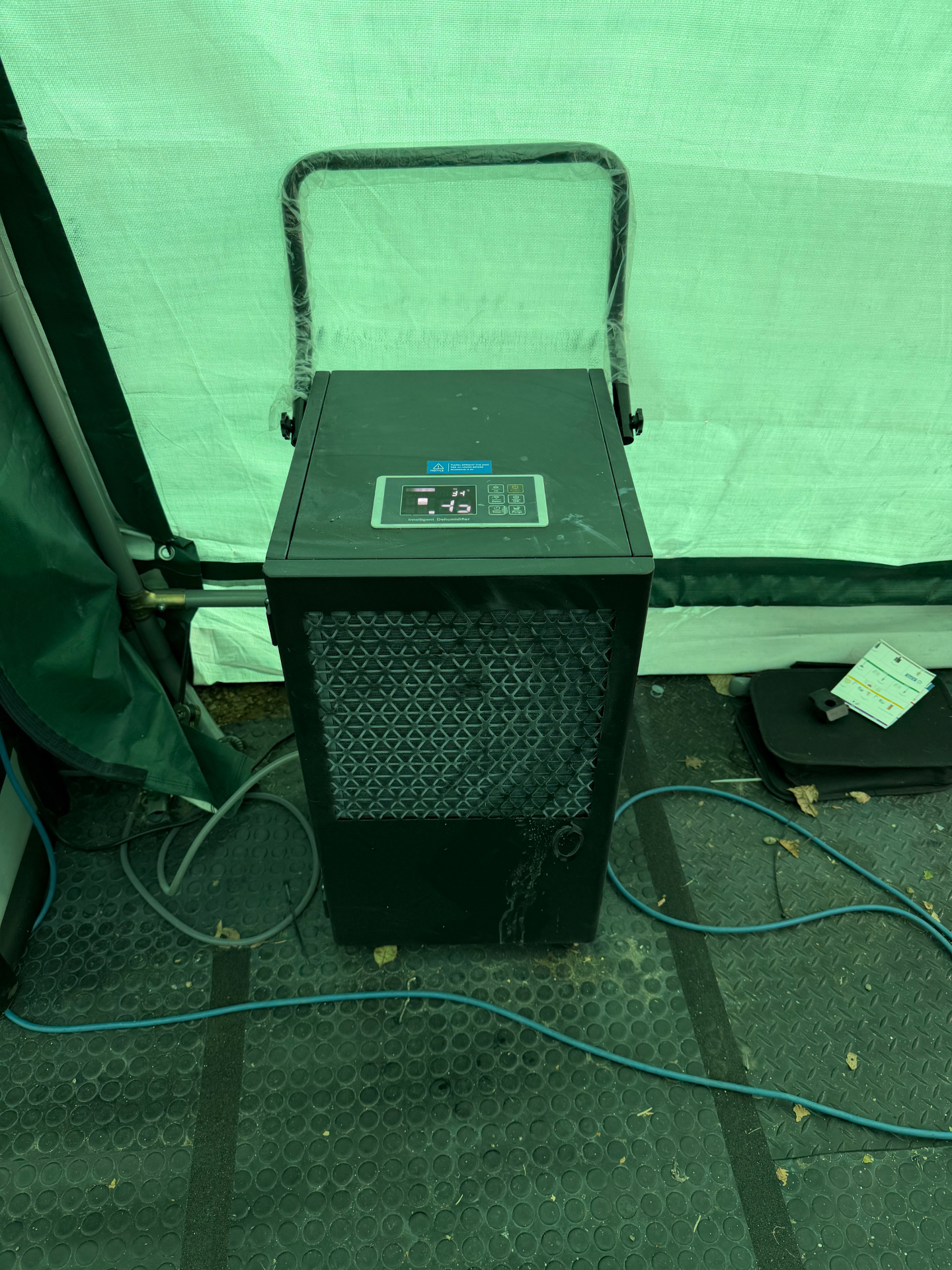
The two technologies
A compressor dehumidifier, sometimes called a refrigerant unit, works like a fridge. It runs air over a cold coil, water condenses out onto the coil and drains into a tank, and the dried air is returned to the room. A desiccant dehumidifier has no cooling coil at all. It passes air through a slowly rotating wheel coated in a moisture-absorbing material, then drives the collected water back out of a portion of the wheel with a regeneration heater so that the wheel is continuously renewed.
The critical point for an unheated garage
A compressor unit needs a coil colder than the air to condense water out of it. As the garage cools, the coil drops towards freezing, frosts over, and the machine spends its time running defrost cycles instead of extracting moisture. It hums away, the tank stays nearly empty, and the owner concludes the garage is dry when in fact the machine has stopped working.
Where exactly that happens is the second point on which the published sources disagree, and it is worth setting the disagreement out rather than picking a winner. Motoring Research says a basic compressor unit is ineffective below 15°C. Ole Dissing, writing on classic car storage, says refrigerant units operate down to 5°C and are well suited to central and northern Europe. One US source puts the loss of effectiveness at about 18°C, with the machine shutting off around 5°C. The three are describing the same physics at different points on the curve: a compressor machine does not fail at a line, it declines as the air cools, and how quickly depends on the unit and on how damp the air is. What the sources do agree on is the desiccant side. A desiccant wheel absorbs water regardless of coil temperature and keeps working down to near freezing, around 0.5°C.
A desiccant unit also gives out warm dry air, because of the regeneration heating stage, which is useful in a cold garage: it lifts the temperature of the space a little relative to the dew point. Ole Dissing makes the complementary point about the other technology, that a refrigerant unit returns roughly two and a half times its energy input to the room as heat, so neither machine is simply a cold appliance.
The efficiency argument reverses
Desiccant units use more electricity for the same extraction than a compressor unit does in warm conditions, which is why compressor units dominate the general household market. The comparison inverts as the temperature drops. In a warm space the compressor unit is the cheaper machine to run; in a cold one it is the desiccant unit that actually removes water, and a machine that works inefficiently beats a machine that does nothing. Judge the two by the temperature of the space they will live in, not by the running-cost figure on the box.
Whichever machine you choose, a humidistat set at about 50% is the target, with the reasoning set out under running it day to day.
What to look for, by capability rather than by brand
This archive names no make or model, quotes no price and links to no retailer. Judge a machine on four capabilities, all of which decide whether it is still working in February.
- A humidistat. The machine should run because the air is damp, not because a timer says so. This is the single feature that turns a dehumidifier into a controlled installation.
- Auto-restart. After a power cut, a unit without it wakes into standby and sits there, doing nothing, until somebody notices. In a garage visited once a month that can mean an entire damp spell unprotected. A unit that resumes its previous settings by itself is worth more than any extraction-rate figure.
- Continuous drainage. A full tank stops the machine, and a machine that has stopped is doing nothing at all. Routing the hose is covered under drainage and continuous running.
- Low temperature operation, if the garage is unheated. Read what the maker states about the lowest working temperature rather than assuming, given how widely the published thresholds for compressor units vary.
Insulating the space changes the answer
None of the above is fixed, because the technology choice follows the temperature you hold. Meaco describe a case where a garage was fitted with PIR insulation panels and a low-wattage tube heater, after which a compressor unit became the sensible choice, precisely because the temperature was being held up out of the range where a compressor struggles. If you are prepared to insulate and to keep steady background heat on, you move the whole problem into compressor territory and gain the running-cost advantage. If the garage is going to stay cold, choose desiccant and do not fight it.
Safety
A garage holds fuel and fuel vapour. Run any dehumidifier, heater or charger from an RCD-protected circuit, avoid daisy-chained extension leads, keep hoses and cables clear of the door, and follow the manufacturer’s instructions for unattended operation.
Running a dehumidifier day to day
Owning the right machine is only the start. These are the questions that come up once it is installed and the car is tucked away for the season.
What humidity to aim for, and why the published figures disagree
Ask six sources what humidity a car should be stored at and you get six answers. Rather than resolve the disagreement, which nobody is in a position to do honestly, here is what each of them actually says.
- Auto Classica Storage and Ole Dissing both give 40% to 60%, on the basis that rust all but stops below 60% while leather, wood and rubber can dry and crack below 40%.
- CarCapsule gives 40% to 50%, citing corrosion research from the US National Institute of Standards and Technology.
- Cotes gives 35% to 55%.
- Munters gives 45% to 50%, and elsewhere simply below 50%.
- Dantherm gives 55% to 60% at 18°C to 20°C, which is guidance written for a professional storage facility with staff moving about in it rather than for a domestic garage.
The practical conclusion sits in the overlap. Nearly every source overlaps between 45% and 55%, and that is the sensible target for a home garage. The reason the numbers differ at all is that each is balancing two opposite risks and weighting them slightly differently. Above 60% corrosion accelerates, and above 70% mould grows on leather, carpet and the hood lining. Below 40% the organic materials suffer, as leather, wood and rubber give up moisture they need. Anyone quoting a single figure has simply chosen a point inside that band and stopped explaining.
There is also a practical limit on chasing a low figure. Holding a much drier space costs electricity for a diminishing return, especially in a structure that is not airtight, which is a matter of general principle rather than a claim from any of the sources above.
The most important point on this page
Every humidity figure on this page assumes clean metal. Salt deposits are hygroscopic, meaning they pull moisture out of air that would otherwise be perfectly safe and hold it against the steel as a wet film, which is why the Canadian Conservation Institute treats salt-contaminated metal as a separate case needing much drier storage than clean metal does. The practical consequence is stark: a car laid up with road salt on its underside will corrode inside a garage held at 50%, and no realistic dehumidifier setting will prevent it. Washing and thoroughly drying the car, paying attention to the underside, wheel arches and sills, before it goes away matters more than the humidistat setting does.
When to run it, and how often
This is the question owners most want a table for, and a table is the one thing that cannot honestly be given. How much a machine runs depends on the size and construction of the space, what the ground beneath it is doing, the season, and how wet the car was when it went in. Two identical machines in two identical garages a mile apart will behave differently if one stands on sealed concrete and the other on a slab over damp ground.
What answers the question properly is instrumentation rather than a schedule. A cheap hygrometer, left in the garage and read on visits, tells you what the space actually does across a week. A humidistat then acts on that automatically, running the machine only when the humidity rises above the set point and stopping when it falls back. That is why the setting matters and a timer does not: a timer runs the machine when the clock says so, which has no relationship to when the air is damp.
Leave it on the humidistat year round rather than seasonally. Corrosion follows relative humidity rather than the calendar, and mild damp air meeting cold metal in spring and autumn can be as damaging as midwinter. Overnight is often the worst window, because falling temperature raises relative humidity even when the moisture content of the air has not changed. In practice a machine may barely stir for months of settled weather and then work hard for a day or two after a wet drive puts a soaked car into a closed space. Both are the system behaving correctly.
Ventilation, and keeping the space closed
The usual advice reverses once a dehumidifier is involved. Opening a garage up for airflow is sound advice for a garage with no dehumidifier in it. Once a space is being dehumidified, it becomes a controlled volume, and opening the doors means drying the outdoors. On a cold damp day it imports a pulse of moist air that condenses on the coldest surfaces before the machine can catch up. Ventilate an untreated space; keep a treated one as closed as is practical. If you need to work on the car, open the door, do the work, then close up and let the machine recover before you leave. Frequent opening is the single biggest reason a properly sized dehumidifier fails to hold a stable humidity.
Covers indoors
In a space held near 50%, a cover is essentially a dust sheet. If one is used it must be breathable, never plastic or tarpaulin, and never placed over a car that is not thoroughly dry. There are also two honest arguments against covering at all in a controlled garage. A cover shifting on a dusty car can abrade paint, and a cover hides things an owner wants to notice early, such as a fluid leak or evidence of mice.
Floors, especially under temporary shelters
Bare earth and grass release a great deal of moisture that rises directly into the underside of the car. Hardcore topped with gravel is much better because it drains. The proper solution for a shelter pitched on open ground is a vapour barrier across the footprint, and a durable plastic floor mat under the car does that job. One practical warning: sealing polythene or matting over grass will kill the grass beneath it, which is fine for a storage bay and a surprise to anyone not expecting it. A bare concrete floor in a fixed garage releases moisture too, unless it is sealed or covered.
Positioning and airflow: where to put the dehumidifier
A dehumidifier can only dry the air it can reach. Place it badly and you end up with a dry patch around the machine, damp corners elsewhere, and sometimes fresh condensation on the car where the warm exhaust air hits cold metal. Positioning is about giving the machine access to the whole volume of the garage and avoiding local hot and cold spots.
Central, open, and off the floor
The ideal position is roughly central, with clear space on all sides. Most units need at least 15–20 cm of clearance behind and to the sides for intake, and more in front for the warm exhaust. Tucking the machine into a corner traps the exhaust against the wall, recirculates already-dry air back into the intake, and leaves the far end of the garage untouched. Standing it on a small platform or shelf raises the intake above any puddles or floor-level dust, and helps the dry exhaust mix across the room rather than hugging the concrete.
Do not blow warm air directly onto the car
The exhaust from a desiccant dehumidifier in particular is warm and dry. If that stream plays directly onto one panel of a cold car, the panel warms locally and the surrounding metal stays cold. When the fan cycles off, the warmed panel can cool below the dew point of the now-drier air and attract condensation exactly where the airflow was aimed. Point the exhaust across the room, not at the car, and let the air mix naturally.
Reach the dead zones under and behind the car
The car itself blocks airflow. The space underneath it, behind the rear seat bulkhead, inside the wheel arches and behind the doors are the last places to dry and the first to condense. A dehumidifier placed at one end of a long garage will rarely reach the other end once the car is in the way. In a larger garage, a small, low-power circulation fan helps push the dry air slowly around the car without creating the direct hot blast you want to avoid. The aim is gentle mixing, not a gale.
Watch for new condensation points
A dehumidifier changes the temperature and moisture profile of the room. After the first few days, check the usual cold spots: the inside of the up-and-over door, the window if there is one, the bare concrete floor, and any exposed steel lintels or beams. If condensation appears there, the air is being dried but those surfaces are still below the new dew point. The fix is usually to raise the minimum temperature slightly with a low-wattage heater, or to improve insulation on the surface that is sweating, rather than to lower the humidistat further.
Wherever the unit ends up standing, it needs a drain that works unattended, which is the subject of the next section.
Quick positioning checklist
- Central, with clearance on all sides and room for the exhaust to spread.
- Raised slightly off a bare concrete floor if possible.
- Exhaust pointed across the room, never directly at the car.
- Clear path to the far corners and under the car, helped by gentle circulation.
- Door kept closed while the machine runs; no frequent opening and closing.
- Continuous drain fitted and checked for loops or blockages.
- Auto-restart enabled and the cold spots inspected after the first week.
Drainage and continuous running: keep water away from the car
A tank means somebody has to walk out and empty it, in January, before it fills and the machine shuts down. Plumb the unit to a sink, gully, soakaway or condensate pump instead and the problem disappears for the season. Routing matters as much as the machine itself, since a hose that drains badly puts water exactly where you do not want it: under the floor, against a wheel, or in a puddle that re-evaporates and raises the humidity you are trying to lower. While you are setting it up, confirm the auto-restart setting, so a power blip does not leave the machine standing idle for weeks.
Run the hose with continuous fall to the outlet
The hose should fall steadily from the machine to the drain, gully or condensate pump, with no sags, low points or loops that can hold water. A low loop acts as a water trap: it blocks air movement, encourages algae and slime, and can siphon back into the machine when the tank empties. If the outlet is lower than the unit, route the hose so it descends all the way. If it has to rise at any point, keep the rise short and fit a small condensate pump rather than relying on gravity.
Keep the hose clear of the car and wheels
Route the drain well away from the car, not across the floor beneath it. A hose lying under the car is easy to trip over, can dislodge, and will wet the floor exactly where moisture is most damaging. Aim for a path that carries water to a gully, sink, or external drain without crossing the storage bay. If the only drain is on the opposite side of the car, run the hose along a wall or in a corner rather than across the middle of the floor.
Secure the hose so it cannot wander
A drain hose that slips out of a sink or gully can empty litres of water onto the floor overnight. Use a clip, cable tie or dedicated drain-hose retainer at the outlet, and make sure the machine end is fully seated and not relying on friction alone. Check both ends when you set the lay-up, and check them again after the first few days of running.
Avoid standing water near the floor or wheels
Even a small puddle under the car evaporates back into the air and can keep the local humidity higher than the rest of the garage. It also wets tyres, which can leave them sitting in moisture for months. If the drain empties into a container, use one with a lid to slow evaporation and empty it regularly. Better still, plumb to a permanent drain so the water leaves the building entirely.
Think about frost
In an unheated garage a drain hose that passes through a cold area can freeze and block, causing the machine to shut down or overflow. Run hoses inside the heated envelope where possible, insulate any short external section, or choose a route that drains quickly before temperatures drop. A frozen hose is a common reason a dehumidifier appears to fail in midwinter.
Use the right bore and length
Manufacturer-supplied hoses are sized for the pump or gravity flow the machine expects. Extending with a much narrower or longer hose can restrict flow and cause leaks at the coupling. If you need a long run, use the correct diameter and avoid sharp bends. A kinked hose behaves like a blockage and can force water out of the machine's internal tank instead.
Drainage checklist
- Continuous fall from machine to outlet, no sags or loops.
- Hose routed away from the car and not under wheels.
- Both ends secured and checked after the first few days.
- No standing water beneath or near the car.
- Frost protection considered for any external run.
- Correct hose diameter and no kinks or sharp bends.
Troubleshooting a damp storage space
A controlled garage should smell dry, feel dry, and show no fresh corrosion after the first few weeks. If it does not, the symptoms point at specific causes. Treat the symptom rather than turning the humidistat lower and hoping for the best. Damp panels, misted glass and wet patches under the car have their own treatment further down this section.
Damp patches on the floor or walls
Most likely cause: the dehumidifier is not removing water fast enough, or water is entering from outside faster than the machine can cope. Check for a leaking gutter, a failed door seal, rising damp through an unsealed concrete floor, or a drain hose that is leaking or pooling locally.
Fix: fix the source first. Seal the floor with a damp-proof coating or lay a vapour barrier, repair door seals, clear gutters, and re-route any hose that is wetting the floor. Only then consider a larger dehumidifier.
Musty smell
Most likely cause: the relative humidity is still high enough to support mould and bacterial growth, usually above 60% for extended periods. It can also mean the car was put away damp, the interior is trapping moisture, or a cover is not breathable.
Fix: check the humidistat reading and the dehumidifier's extracted water volume. A musty interior needs the car fully dried, the windows left slightly open if safe, and a breathable rather than plastic cover. Inspect for mould on leather and carpets early.
Corrosion spotting on bare metal
Most likely cause: the humidity has been above the safe range for that metal for long enough to start surface oxidation. It is common on brake discs, exhaust tips, plated fittings and any bare steel. Salt residue from the last drive accelerates it dramatically.
Fix: clean and dry the affected parts, then address the humidity and temperature control. Discs can be lightly cleaned and protected; exhaust tips often polish off. If spots appear on painted or plated surfaces, the storage conditions need attention before they worsen.
Condensation on and around the car
Condensation on the car is the symptom owners notice first, because it is the one place you do not want it. The cause is always the same: the metal is colder than the dew point of the air touching it. That happens when warm damp air reaches a cold body, when the garage is opened frequently on wet days, when an oversized machine short-cycles instead of holding a steady humidity, or when warm exhaust air is aimed at one panel. The remedy depends on where the moisture is appearing.
Condensation on the bodywork
Airflow adjustment: make sure the dehumidifier exhaust is not aimed at the car. Warm dry air hitting a cold panel can cause condensation when the fan cycles off. Move the unit or deflect the exhaust across the room.
Placement adjustment: if the car is in a dead zone at the far end of the garage from the dehumidifier, add a small circulation fan to move dry air gently around it. Do not create a direct blast; the aim is slow mixing.
RH setpoint: lower the humidistat by 5% and give the space 24–48 hours. If the condensation disappears, the dew point was simply too close to the panel temperature. If it persists, the problem is more likely cold panels than high humidity, so hold a steadier temperature with gentle background heat and stop opening the garage on damp days.
Condensation under the car or inside the wheels
Airflow adjustment: the underside is a natural dead zone. A small fan angled to move air beneath the car, or a dehumidifier positioned so its exhaust sweeps the lower bay, helps. Avoid pointing warm air directly at brake discs or suspension, which can cause localised sweating when the airflow stops.
Placement adjustment: raise the unit slightly so its exhaust can reach the lower volume, and clear any clutter that blocks air from circulating beneath the car.
RH setpoint: the floor and wheels may stay colder than the body. A lower setpoint helps, but only if the dehumidifier can actually reach that area. Pair a lower target with better circulation rather than simply turning the dial down.
Condensation inside the car
Airflow adjustment: a closed car traps moisture from the interior fabrics and carpets. Leave the windows slightly open if the garage is secure and rodent-proof, or fit small interior vents. A gentle flow of dry air through the cabin is more effective than a very dry garage around a sealed, damp car.
Placement adjustment: position the dehumidifier so dry air can reach the cabin, not just the outside panels. If the car is covered, make sure the cover is breathable and not tucked so tightly that it blocks air exchange.
RH setpoint: the interior will lag behind the garage. Drop the target by a few percent and allow several days for the upholstery and carpets to give up their stored moisture.
The general rule
Condensation means a surface is below the dew point. You can fix it by lowering the dew point (drier air), raising the surface temperature (gentle heat), or improving the airflow so the car dries evenly. The wrong response is to aim the dehumidifier harder at the car; that often creates the temperature differences that cause the problem.
Which type of dehumidifier for your space?
Everything above argues that the choice turns on your space, not on a specification sheet: what the floor is, whether the air stays above the compressor threshold, and what the climate does to an unheated building. The short form below applies that reasoning to your own answers and recommends a type. It will not pretend to precision the sources do not have, so it recommends a type and explains itself, and leaves the sizing to a hygrometer in your garage.
Interactive advisor
Six questions about your space, and the tool will recommend a type of dehumidifier and explain its reasoning. It will not name a size, a brand or a running cost: those depend on the specific space and can only be settled with a hygrometer.
Answer all six questions above and the recommendation will appear here.
The contested question: should you start it during storage?
This is the one storage question on which reputable sources genuinely disagree, and it is more useful to set out the disagreement than to pretend it is settled.
The case against starting it
Hagerty advise against occasional starting during a lay-up, on the basis that you may do more harm than good if the engine does not reach temperature and run for an extended period. They also raise the practical hazard of exhaust gas building up in a closed garage, which is a real risk rather than a theoretical one.
The case for periodic running
American Collectors Insurance take the opposite position for most classics of the 1950s and later, holding that periodic running is beneficial for seals and fluids, which are circulated and redistributed rather than left to dry out and shrink. Their position carries an explicit condition: the engine must reach operating temperature.
Why a short idle is the worst of both
The technical reasoning, as set out by a widely published technical writer, explains why the two camps can both be right. When an engine is run only briefly, the coolant may reach around 180°F while the oil is only just above 100°F, because oil warms far more slowly than coolant, especially at idle with little load. Combustion produces water as one of its products. Some of that water finds its way past the rings into the crankcase, and in oil that never gets hot enough to boil it off it forms acids that can attack bearings and other internals.
That is the whole argument in one sentence: the harm comes from cold oil, not from running the engine. A ten-minute idle contaminates the oil and leaves the water sitting in it for another month. A proper drive gets the oil hot enough to drive the water back out.
What a professional storage firm says
A professional storage firm puts it plainly: if the car cannot be driven properly, it is often better not to start it at all.
The ten-minute idle, treated sceptically
A piece of advice repeated everywhere is to idle the engine for ten minutes now and then during storage, to circulate the oil and drive off moisture. It is worth treating with scepticism. An engine that does not reach full operating temperature produces condensation in the exhaust and the crankcase rather than removing it, so the practice can add the very water it is supposed to expel, and many experienced owners consider a brief idle worse than leaving the car alone.
Opinion is genuinely divided on it and this archive will not pretend to settle it. What every source agrees on is the alternative: a proper drive, long enough for everything to get hot, is good for the car.
The decision rule
Rather than a blanket instruction, use the test the sources all point at. If you can take the car out and drive it far enough that the oil as well as the coolant reaches full operating temperature, and conditions are dry and salt-free, that drive does the car good. If you cannot, leave it alone and let the lay-up preparation do its work. The thing to avoid is the ten-minute idle on the drive, which delivers none of the benefit and all of the contamination.
The rest of the checklist, in detail
Fuel and how full to leave the tank
Leave the tank full. Air space above the fuel is where moisture condenses onto the tank walls, and an older steel tank will corrode from the inside on that condensation. A full tank also reduces the surface area over which volatile fractions can evaporate. Choose E5 super unleaded over E10 where you can. The ethanol question is covered properly on the E10 petrol page, which sets out what ethanol does to a classic fuel system and what the current fuel situation actually is.
Stabilisers and additives
A storage stabiliser slows the oxidation and gum formation that turn standing petrol into varnish in the float chambers and jets. Add it to a full tank, then run the engine long enough for treated fuel to reach the carburettors, otherwise the tank is protected and the fuel already in the carbs is not. Hagerty caution that a stabiliser cannot remove water that has already separated out in the tank, which is an important limit: if you know or suspect there is water down there, the answer is to drain it rather than to dose it. The wider question of what does and does not belong in a Stag’s fuel and oil is covered on the additives page.
Oil
Change the engine oil and filter before the car stands, not when you wake it. Used oil carries combustion by-products, including the water and acids described above, and leaving that mixture in contact with bearing surfaces for four or five months is the most avoidable damage in the whole lay-up. Fresh oil costs a fraction of a bearing shell. Run the engine briefly after the change so clean oil coats the internals, then let it stand.
Coolant and antifreeze
On most cars winter coolant means frost protection. On a Stag it means considerably more. The antifreeze is carrying the corrosion inhibitors that protect aluminium heads sitting on an iron block, and those inhibitors deplete with time regardless of mileage. Coolant that is three or four years old may still prevent freezing while having lost most of its ability to prevent the electrolytic corrosion that silts a radiator and leads to overheating. Check the strength and the age, and treat a lay-up as the natural opportunity to renew it.
The battery
A lead-acid battery left to self-discharge over a winter will sulphate, lose capacity and may not recover. There are two sound approaches. An intelligent trickle charger or conditioner holds the battery at full charge without overcharging and can be left connected all season, which also keeps any clock or radio memory alive. Alternatively disconnect the battery, or remove it to a dry bench and charge it periodically, which eliminates parasitic drain and any risk from unattended equipment. What does not work is leaving it connected and unattended with no charger.
Tyres, flat spots and the floor
A tyre carrying the car’s weight on one contact patch for months can take a set, which shows as vibration for the first miles in spring and occasionally does not settle out at all. Inflating a few psi above normal for the stand reduces deflection, and moving the car every few weeks so a different part of the tread bears the load is better still. Remember to set the pressures back before driving. The floor matters too: an unsealed concrete slab passes moisture up into the rubber and into the underside of the car, so boards, mats or a vapour barrier under the tyres and the car are worth the trouble.
The handbrake
Leave the handbrake off and chock the wheels instead. Shoes held against a drum for months in a damp garage can bond to the surface through surface corrosion, and freeing them ranges from an irritating morning to a rear-end strip. Chocks in front of and behind one wheel each side, on a level floor, do the job the handbrake was going to do.
Covers
Use a breathable cover indoors. Breathable fabric keeps dust and abrasive grit off the paint while letting any moisture that reaches the panels evaporate away. A non-breathable plastic sheet does the reverse, holding condensation against the finish for the whole winter, and it is a common cause of bloomed paint and microblisters that were not there in October. The rule that outranks the fabric choice: never cover a damp car. If there is any doubt, leave the car uncovered until you are certain it is dry.
Where to leave the hood or hard top
Store the soft top up and dry rather than folded away. A hood folded down while damp, then left for months, grows mould along the folds and can crease permanently. A hard top left fitted protects the interior well, though it needs to come off onto a proper stand rather than propped against a wall if you remove it. Care of both is covered on the soft top and hard top page.
Mice, rats and a stored car
A car that stands in a garage from October to March is, from a mouse’s point of view, a warm dry nest box with its own food store and bedding. The engine bay holds heat for hours after the last run, the air filter box and the silencer are sheltered tubes, and the seat foam, carpet underfelt and hood lining are nesting material. House mice can get through a gap of 5 to 6 mm, about the diameter of a pencil, so an ordinary up-and-over door with daylight under it is no barrier at all.
The damage they do
The expensive item is the wiring loom. Rodents’ front teeth grow continuously and they gnaw to wear them down, and wiring insulation, fuel hose, rubber trunking and sound-deadening felt are all chewed. A loom that has been chewed in several places is a rewire, and a chewed fuel hose on a petrol car is a fire risk. Nests in the air filter box and the exhaust tailpipe are found when the car will not start or runs badly in spring. Carpets, seats and door trims are shredded for bedding, and the smell of a mouse that has died in the heater box or under the carpet takes a long time to clear.
On a Stag the places to look are the air cleaner box above the engine and its intake elbows, the heater box behind the dashboard, the hood well behind the seats, which is sheltered and lined, and the boot. The hood itself, whether vinyl or mohair, is nesting material, so a Stag stored with the hood up and the hard top off is more exposed than one stored under its hard top.
Two further points worth knowing. Insurers commonly treat rodent damage as damage that happened gradually, which most motor policies exclude, and a UK Financial Ombudsman decision in 2018 did not uphold a complaint against Aviva, which had refused a claim for chewed engine wiring on exactly those grounds. And the story that modern soy-based wiring insulation attracts rodents is unproven; a US court dismissed a class action against Toyota on the point in 2018 because the owners could not show a defect, and Toyota said it knew of no scientific evidence that rodents are attracted to soy-based insulation. There is no reason to think an old loom is any safer than a new one.
What works
Keep them out of the building first. Seal gaps round pipes, cables and door frames with wire wool packed in and covered with filler or mortar, since mice will chew through foam, plastic and wood but not steel wool. Fit a brush strip or a rubber seal to the bottom of the garage door. Keep the floor clear, keep bird seed, pet food and lawn seed in metal or heavy plastic bins with lids, and do not leave bags of anything edible, including grass seed and bulbs, in the same building as the car.
Then make the car itself unwelcoming. Clean out every crumb before lay-up and leave nothing edible inside. Close the windows fully, or if you leave them cracked for ventilation, cover the gap with fine mesh. Bung the exhaust tailpipe and the air intake with a rag or a rubber bung, and hang a large label on the steering wheel saying so, because a forgotten exhaust bung is a classic spring mistake. Leave the bonnet up if the garage is secure: a cold, open engine bay is less attractive than a warm enclosed one, and you can see what is happening.
Set traps and check them. Conventional snap traps baited with peanut butter or chocolate, set against walls where mice run, are cheap and reliable, and a trap that has caught nothing in a month is useful information in itself. Check them weekly along with the car, and look for the signs: droppings the size of a grain of rice, shredded paper or felt, gnaw marks, and a musky smell. A fortnightly walk round the car with a torch, looking in the air filter box, under the scuttle, in the boot and under the seats, catches a problem while it is still one nest and not a rewire.
What is unproven
Ultrasonic repellers are widely sold and the evidence is mixed: one published single-house trial found fewer mice caught while a unit was running, but the general view of research bodies and pest control advisers is that rodents get used to the sound within days and that the devices are not a substitute for proofing and traps. Peppermint oil, dryer sheets, mothballs and cat hair are all repeated on forums; none has good evidence behind it, and naphthalene mothballs have not been legal to sell in the UK since 2008. By all means use them, but not instead of the measures above.
Poison
Rodenticide is a last resort. It is sold to the public only in small packs for use in and around buildings, it must be kept where pets and children cannot reach it, and a poisoned mouse often dies somewhere in the car, which is the smell problem again. If you have an established infestation rather than a single visitor, a professional pest controller is a better call than more bait.
Glue traps are banned for the public across Great Britain: in Wales since 17 October 2023, in England since 31 July 2024, where only licensed professional pest controllers may use them, and in Scotland since 1 July 2026, where sale and possession are banned as well. In England and Wales they are still on sale, which is not the same as being legal to use.
In spring
Before the first start, take the air filter off and look inside the box, lift the carpets and check under the scuttle and round the fuse box and loom for chewed insulation and nesting. Remove the bungs. If you find chewed wiring, trace it fully before switching on; a short to earth is cheaper to find with a meter than with a fuse.
The Stag’s winter priority: coolant and corrosion
The Stag V8 has an iron block and aluminium heads, a mixed-metal pairing that needs corrosion-inhibiting antifreeze all year round. Without a live inhibitor the two metals set up electrolytic corrosion, aluminium oxide sludge builds in the radiator and water passages, cooling is choked, and the result is overheating and, eventually, warped heads and blown gaskets. A car standing all winter on tired coolant carries on corroding while it sleeps, which is why a lay-up is the ideal moment to refresh the cooling system:
- Drain, flush and refill with a 50/50 mix of corrosion-inhibited antifreeze and distilled water, the inhibitor rated for mixed aluminium and iron.
- Use distilled water rather than tap water, whose minerals worsen corrosion.
- Bleed the air out thoroughly. The Stag traps air readily, so make sure the system is genuinely full with the thermostat jiggle-pin uppermost.
- Inspect the radiator and hoses while you are there. A silted radiator or a perished hose is a spring failure waiting to happen.
The car is steel-bodied, so damp means rust in the sills, arches and rear suspension mountings, and salt makes it far worse. That is the main reason to lay a Stag up for the gritted months at all. See rust and bodywork for where to look, and timing chains for the other job worth doing while the car is off the road.
The lay-up checklist
Work down this list in order on the day the car goes away. Most UK classics are laid up from roughly November to March.
- Wash and dry the car completely, underside included, and vacuum the interior.
- Wax or seal the paint and feed the leather.
- Fill the fuel tank, preferably with E5 super unleaded, add a storage stabiliser and run the engine so treated fuel reaches the carburettors.
- Change the engine oil and filter before the car stands, not after.
- Check the antifreeze strength and that it is a corrosion-inhibited type suited to mixed aluminium and iron.
- Put the battery on an intelligent conditioner, or disconnect and remove it to a dry bench.
- Set the tyres a few psi above normal and note the pressures for spring.
- Leave the handbrake OFF and chock the wheels.
- Bung the exhaust and air intake against rodents, and label the bungs.
- Set the dehumidifier running with a continuous drain, and check the auto-restart setting.
- Fit a breathable cover, only once the car is bone dry.
- Leave the hood up and dry, or the hard top fitted.
Spring recommissioning
- Remove the exhaust and intake bungs before anything else.
- Check coolant, oil, brake and clutch fluid levels, and look underneath for fresh leaks.
- Reconnect the battery and check it holds a charge under load.
- Return the tyres to normal pressures and inspect the sidewalls.
- Release the chocks and check the handbrake and footbrake work before moving off.
- Look over the fuel lines and hoses, which perish over a stand.
- Build oil pressure before the first fire-up, then bring the car fully up to temperature on a proper drive.
Check the brakes properly before the first proper drive, and see starting in extreme heat for the summer counterpart to this page.
Summer storage
Summer looks kinder to a stored car than it is. The threats change rather than disappear. Direct sunlight fades paint, cracks dashboards and hardens rubber and tyres. Warm days followed by cool nights swing the air through the dew point, so condensation remains a summer problem. A cover trapping heat and moisture over a still car will grow mould on leather and carpet, which makes ventilation as important in July as in January. Pests are more active, fuel stales faster in the heat, and a sheeted temporary shelter can reach remarkable temperatures inside, which makes venting the ends and using a breathable inner cover essential rather than optional.
Heating: when it helps and when it does not
Heat in a storage garage is not about comfort. Its only purpose is to keep the car’s metal reliably above the dew point and to avoid the swings that themselves cause condensation. A garage heated in the evening and cold overnight can be worse than one that is simply cold all winter.
Many owners reach for a heater first, on the reasonable-sounding logic that warm air holds more moisture, so warming the garage must dry it. Ole Dissing addresses this directly, stating that heating is around two and a half times less efficient than dehumidification as a way of lowering relative humidity, and, more importantly, that heating a garage will not stop a cold car attracting condensation. The reason is thermal mass. Air warms in minutes; an engine block, a chassis and a tank of fuel take a great deal longer, so for hours after the heater comes on the car is still the coldest thing in the room and moisture goes on condensing onto it.
The bar heater question deserves an honest answer rather than a polite one. A small heater in an uninsulated single garage is expensive to run and largely futile as a drying measure, because the heat leaves through the roof, the door gaps and the walls about as fast as it arrives. Where heat does earn its keep is narrower than people expect: lifting the temperature of the metal itself above the dew point, steadily and continuously, rather than warming the air in bursts. That means gentle continuous background heat, a tubular heater or a frost-thermostat radiator, paired with sealing the obvious gaps and insulating the structure. As noted above, insulating and holding a steady temperature is also what moves the space into the range where a compressor dehumidifier is the efficient choice, so the two decisions belong together rather than being made separately.
The garage itself, and the floor beneath it
Most published guidance treats the building as a given and talks only about the machine inside it. The building decides how hard that machine has to work. Two cases cover almost every owner in Britain.
The brick or stone single garage
The typical example is uninsulated, single skin or thereabouts, with a concrete floor and an up-and-over door that leaves a visible gap at the sides and along the bottom. It has useful thermal mass, so it swings in temperature more slowly than a shelter does, which is a genuine advantage. Its moisture arrives from three places: through the door gaps as damp outside air, up through an unsealed slab, and off the walls if a gutter is overflowing or ground level outside sits above the damp course. The cheap improvements are the unglamorous ones. Clear the gutters and check where rainwater lands, fit brush or rubber seals to the door edges and threshold, and deal with anything stored in there that is itself wet, such as garden timber, cardboard or bags of compost. None of that costs much, and each removes work the dehumidifier would otherwise be doing forever.
The temporary steel-framed fabric shelter
A shelter of the Clarke type changes the problem rather than solving it. There is almost no thermal mass, so the inside tracks the outside temperature closely and swings sharply between a sunny afternoon and a clear night, which is exactly the pattern that produces condensation. The cover itself is the coldest surface at night, so water forms on the inside of the sheeting and can drip onto whatever is below it. The frame members do the same thing on a smaller scale. A shelter can still be an excellent storage space, and it is a great deal better than standing outside, provided the two weaknesses are addressed: the ground beneath it, and gentle continuous drying rather than the assumption that a roof is enough.
The floor, which matters more than people expect
Bare ground gives up moisture continuously. Soil and grass are wet most of the year in this climate, and that water evaporates upwards into the space day and night, straight into the underside of the car, which is the part an owner can least easily inspect. A concrete or stone floor is a considerable improvement even when unsealed, because it slows the process and gives a surface that can be swept dry. Hardcore is better than soil because it drains.
In a shelter pitched on grass or hardcore, a sealed vapour barrier across the footprint is the single cheapest improvement available. The principle is what matters rather than any particular product: a continuous impermeable layer, laid flat, taken out beyond the car in every direction and sealed at the joins, so that ground moisture is stopped before it reaches the air the machine is trying to dry. Gaps and overlaps that are not sealed leak, and a barrier that stops short of the car’s footprint achieves very little. This archive does not specify materials or thicknesses, and anyone selling one will. One practical warning: sealing a barrier over grass will kill the grass beneath it, which is fine for a storage bay and a surprise to those not expecting it.
Dehumidifier pouches and crystals
The tubs and hanging sachets sold as car dehumidifiers are usually calcium chloride, which absorbs water from the air and dissolves into a brine that collects in the base of the tub, or silica gel, which adsorbs moisture onto its surface without liquefying. They are cheap, silent, need no power and are genuinely useful. What they cannot do is dry a garage.
The reason is scale rather than quality. A sachet holds a small fixed quantity of absorbent, and a garage leaks air continuously, so it presents an effectively unlimited supply of new moisture. Inside a car, a boot or a covered cabin, the volume is small and broadly sealed, which is the situation these products were designed for. There they earn their place, particularly in a car that stands with the windows closed and a damp carpet underfoot.
On replacement, CarCapsule suggests swapping them roughly every sixty days from October to April in a humid climate, and notes that silica gel can be dried out in a low oven and reused. Beyond that attributed figure, the honest answer is to look at them: a calcium chloride tub with liquid in the base and no crystals left has finished, and a saturated sachet feels heavy and yields nothing further. Treat all of them as a supplement to a properly dried space rather than a substitute for one.
The battery: disconnect it or keep it charged
A lead-acid battery left standing discharges slowly by itself, and anything on the car drawing a small permanent current speeds that up. A battery allowed to sit flat sulphates, and may never take a full charge again. There are two sound answers and one poor one.
Disconnecting removes the parasitic drain entirely and removes any electrical risk from the car while it stands. The cost is that anything with a memory loses it, and the battery still self-discharges on the shelf, just more slowly, so it wants a check and a top-up charge over a long lay-up. Keeping it on a modern maintenance charger is the other answer, and it is not the same thing as the old trickle charger sitting on a shelf. A trickle charger delivers a constant small current whether the battery wants it or not, and left connected for months it can overcharge a battery and boil off electrolyte. A maintenance charger or conditioner monitors the battery, charges it when it needs it, then holds off, which is what makes it safe to leave connected for a season. The poor answer is the third one: leaving the battery connected to the car and doing nothing.
Safety
Anything left charging unattended deserves care, and more so in a fabric shelter than in a brick garage. Use an RCD-protected supply, keep the charger clear of fuel, fuel vapour and anything combustible, site it where it cannot sit in water, and follow the maker’s instructions on unattended use rather than assuming.
A note on climate
Everything above is written for the United Kingdom and northern Europe, where the problem is a cool, damp, largely unheated space for much of the year. In a hot humid climate the balance shifts: the temperature thresholds that limit a compressor unit stop mattering, condensation behaves differently, and mould rather than frost is the year-round enemy. This archive has no first-hand experience of storing a car in those conditions and will not pretend otherwise.
Storing a classic car: FAQ
Should you start a classic car during winter storage?
Opinion is genuinely divided. Hagerty advise against occasional starting, on the grounds that you may do more harm than good if the car does not reach temperature and run for an extended period, and they note the danger of exhaust gas building up in a garage. American Collectors Insurance take the opposite view for most classics from the 1950s onward, arguing that periodic running benefits seals and fluids provided the engine reaches operating temperature. The two positions agree on the underlying point: a brief idle is the worst option. Either drive the car properly until everything is hot, or leave it alone.
What humidity should a classic car be stored at?
The published figures differ. Auto Classica Storage and Ole Dissing both give 40% to 60%, CarCapsule gives 40% to 50% citing corrosion research from the US National Institute of Standards and Technology, Cotes gives 35% to 55%, Munters gives 45% to 50% and elsewhere simply below 50%, and Dantherm gives 55% to 60% at 18°C to 20°C for a staffed professional facility. Almost every source overlaps between 45% and 55%, which is the sensible target for a home garage. The numbers differ because two opposite risks are being balanced: above 60% corrosion accelerates and above 70% mould grows, while below 40% leather, wood and rubber can dry and crack.
Do I need a dehumidifier in my garage?
It depends on what the garage does to the air rather than on the car. A hygrometer answers it: if the space sits above about 60% for long spells, a dehumidifier is the most direct fix. If it holds in the 45% to 55% band on its own, the money is better spent curing damp at source, sealing the door gaps and putting a vapour barrier under a car standing on bare ground.
Desiccant or compressor dehumidifier for a cold garage?
Desiccant, for a garage left unheated, though the sources disagree on where a compressor stops coping. Motoring Research says a basic compressor unit is ineffective below 15°C, Ole Dissing says refrigerant units operate down to 5°C and suit central and northern Europe, and one US source puts the loss of effectiveness at about 18°C with shutdown around 5°C. Desiccant units are agreed to work down to near freezing, around 0.5°C, and give out warm dry air, at the cost of more electricity for the same extraction.
Should I heat my garage in winter?
Heating is a poor way to lower relative humidity. Ole Dissing states that heating is around two and a half times less efficient than dehumidification for the job, and that heating a garage will not stop a cold car attracting condensation, because the metal takes far longer to warm than the air does. A small bar heater in an uninsulated space is expensive and largely futile. Where gentle background heat earns its place is in lifting the metal above the dew point, not in warming the air.
Do dehumidifier pouches work?
They work at the scale they are built for. Calcium chloride sachets and silica gel packs are genuinely useful inside a car interior or a boot, where the volume is small and sealed. They cannot dry a garage, which leaks air continuously. CarCapsule suggests swapping them roughly every sixty days from October to April in a humid climate, and notes that silica gel can be dried in a low oven and reused. Treat them as a supplement to a dehumidifier rather than a substitute for one.
Should I disconnect the battery or leave it on a charger?
Either disconnect it or keep it on a modern maintenance charger, but do not simply leave it connected and unattended. An old-style trickle charger pushes a constant small current and can cook a battery if left for months; a maintenance charger or conditioner monitors the battery and only tops it up, which is not the same thing. Disconnecting removes the parasitic drain and the fire risk, at the cost of losing any clock or radio settings. Anything left charging unattended, especially in a fabric shelter, should be on an RCD-protected supply and sited clear of fuel and combustible material.
Should you cover a classic car indoors?
Yes, with a breathable cover, and only when the car is completely dry. A breathable cover keeps dust and abrasive grit off the paint while letting moisture escape. A non-breathable plastic sheet does the opposite: it traps condensation against the paint and holds it there all winter. Covering a damp car is worse than leaving it uncovered.
How much fuel should you leave in the tank for storage?
Fill it. A full tank leaves little air space in which moisture can condense on the tank walls, which matters most on an older steel tank. Use E5 super unleaded rather than E10 where you can, and add a storage stabiliser, then run the engine long enough for treated fuel to reach the carburettors. Hagerty caution that a stabiliser cannot remove water that has already separated out in the tank, so a tank known to hold water needs draining rather than dosing.
What is the most important winter job on a Triumph Stag?
Refreshing the cooling system. The V8's iron block and aluminium heads need corrosion-inhibited antifreeze all year round, so a lay-up is the natural time to flush and refill with a 50/50 inhibited mix and distilled water, and to bleed out any trapped air.
Should I drive my Stag in winter?
Best not on salted roads, since salt accelerates the rust these steel-bodied cars are prone to. Lay the car up for the gritted months, or drive only on dry days and wash the underside thoroughly afterwards.
Why are there damp patches on my garage floor?
Water is arriving faster than the machine removes it. Look for a failed door seal, a leaking gutter, an unsealed slab wicking damp upward, or a drain hose pooling water. Cure the source before buying a bigger dehumidifier.
How do I stop a musty smell in my stored car?
A musty smell points to sustained humidity above about 60%, or a car that went away damp. Check what the machine is actually extracting, dry the cabin out, leave the windows ajar if the garage is secure and rodent-proof, and swap any plastic sheet for a breathable cover.
What causes condensation on my car in the garage?
The panels are colder than the dew point of the air touching them. Frequent door opening on damp days, short-cycling of an oversized machine, and warm exhaust aimed at cold metal are the usual triggers. Steady the temperature, keep the door shut, and point the exhaust across the room instead of at the car.
Why is corrosion spotting on bare metal during storage?
Discs, exhaust tips, plated fittings and bare steel oxidise once humidity sits above their safe range, and any salt left from the last drive brings that threshold down sharply. Clean and dry the affected parts, then deal with the humidity rather than the symptom.
How do you store a classic car in an unheated garage?
Treat the air rather than the temperature. An unheated garage is only a problem when the panels fall below the dew point of the air touching them, so the aim is to hold the space at roughly 45% to 50% relative humidity, put the car away washed and completely dry, and use a breathable cover rather than a plastic sheet. In a space left cold, a desiccant dehumidifier is the type that keeps working, and curing damp at source, sealing door gaps and laying a vapour barrier under a car on bare ground matter as much as the machine does.
Is a cold garage bad for a classic car?
Cold on its own is not the problem. Damage comes from moisture condensing on metal, which happens whenever the panels are colder than the dew point of the surrounding air, so a steadily cold garage can be kinder than one warmed in the evening and left to cool overnight. Heating is an inefficient way to lower relative humidity and will not stop a cold car attracting condensation, because the metal takes far longer to warm than the air does.
How long can a classic car sit without being started?
Longer than most owners expect, provided it was laid up properly. Sources genuinely disagree about periodic running: some advise against starting at all during a lay-up, others hold that running benefits seals and fluids. Both agree that a brief idle is the worst option, because the oil never gets hot enough to drive off the water combustion puts into it. So either drive the car until everything is thoroughly hot, or leave it alone until spring and recommission it properly.
How do I keep mice out of my classic car in the garage?
Seal the building (wire wool in gaps, a brush strip on the door), keep nothing edible in it, clean the car out, bung the exhaust and air intake and label the car, and set snap traps that you check weekly along with the car itself.
Do ultrasonic mouse repellers work?
The evidence is mixed and research bodies say rodents get used to the sound within days. Treat one as an extra, not as a substitute for sealing the building and setting traps.
Does classic car insurance cover mouse damage?
Often not. Most motor policies exclude damage that happens gradually, and a Financial Ombudsman decision in 2018 did not uphold a complaint about a refusal on those grounds. Check your policy wording.
Sources named on this page
- Hagerty, on avoiding occasional starting during storage, the exhaust hazard in a closed garage, and the limits of fuel stabilisers where water has already separated.
- American Collectors Insurance, on periodic running being beneficial for seals and fluids in most classics of the 1950s and later, provided operating temperature is reached.
- Meaco, on a garage insulated with PIR panels and warmed by a low-wattage tube heater, after which a compressor dehumidifier became the sensible choice.
- The Canadian Conservation Institute, on metal objects having stable surfaces at moderate relative humidity of 45% to 50%, and on dry environments of 30% or lower being ideal for metals.
- ISO 9223, on the general principle that the lower the relative humidity, the slower the corrosion.
- CarCapsule, on storing at 40% to 50% relative humidity citing US National Institute of Standards and Technology corrosion research, and on swapping in-car dehumidifier pouches roughly every sixty days from October to April in a humid climate.
- Auto Classica Storage, Ole Dissing, Cotes, Munters and Dantherm, on the target humidity figures set out under running a dehumidifier; Ole Dissing additionally on refrigerant units operating down to 5°C, on a refrigerant unit returning roughly two and a half times its energy input as heat, and on heating being around two and a half times less efficient than dehumidification for lowering relative humidity.
- Motoring Research, on a basic compressor dehumidifier being ineffective below 15°C.
Related reading
Advice on this page is general to classic-car storage. Product types are described neutrally and nothing here is a recommendation to buy; always follow the manufacturer’s instructions for any heater, dehumidifier, charger or cover you use.